
Tag: hairlosssupport

  • The Four-Finger Forehead Rule: How to Avoid the “Wiggy” Look

    The Four-Finger Forehead Rule: How to Avoid the “Wiggy” Look

    Let’s talk about wig placement. Because if there’s one thing that screams “I’m wearing a wig” louder than a synthetic shine under office lighting, it’s a wig that’s sitting way too low on your forehead.

    We’ve all seen it, or worse, done it. That moment when your lace front is practically caressing your eyebrows, making you look less like a person and more like someone auditioning for a medieval period drama. But don’t worry, there’s a simple fix. Enter the Four-Finger Forehead Rule, the golden ratio of wig placement that helps you achieve a natural, balanced look every time.

    If you’ve never heard of this rule, prepare to have your wig-wearing world changed.

    What is the Four-Finger Forehead Rule?

    The Four-Finger Forehead Rule is a simple trick used by wig pros and seasoned wearers to ensure their wig hairline sits in the right place, not too high (hello, receding hairline), not too low (bye-bye, natural look).

    Here’s how it works:

    1. Place your little finger at the top of your eyebrows (in the center of your forehead).
    2. Stack the next three fingers above it, ring finger, middle finger, then forefinger.
    3. Where your forefinger ends is where your wig’s hairline should start.

    If your wig is below that point, congratulations, you now have a two-finger forehead and possibly a brand-new personality because no one will recognize you anymore. If it’s too high, you might look like you’re permanently mid-way through a surprised expression.

    This simple measurement ensures your wig sits in a natural, believable position,because let’s be honest, we’re aiming for flawless, not founding father.

    Why Does Wig Placement Matter?

    A poorly placed wig caninstantly turn your look from “effortlessly chic” to “accidentally hilarious.” Here’s why:

    • Too Low = Too Obvious

    If your wig eats up half your forehead, it’s a dead giveaway. The human face is proportioned a certain way, and when you disrupt that by shrinking your forehead, people will notice, even if they don’t know why.

    • Too High = Questionable Choices

    On the flip side, setting your wig too far back makes you look like your hairline started giving up on life years ago. It can also expose too much of your natural hair (or lack of it), ruining the illusion.

    • Just Right = Perfection

    Getting that wig in the sweet spot (hello, four-finger rule) gives you a flattering, well-balanced look that frames your face beautifully and blends seamlessly with your features.

    How to Make Sure Your Wig Stays in Place

    Now that you know where your wig should sit, let’s make sure it stays there. Because there’s nothing worse than setting your wig in the perfect spot only for it to slide down mid-conversation, turning your forehead into a mystery of shifting proportions.

    1. Use a Wig Grip

    A wig grip band is your best friend, it locks your wig in place without glue or clips.

    2. Secure Your Lace Front

      If you’re using wig glue, tapes or adhesives, apply just enough along your hairline, not halfway down your forehead like you’re prepping for a face lift.

      3. Adjust & Check

        Before leaving the house, do a quick mirror check. If your wig is making you look like you have a forehead the size of a postage stamp, slide it back. If you’re exposing half your scalp, bring it forward. Balance is key.

        What If You Have a Naturally Small or Large Forehead?

        Not everyone has the same forehead real estate, and that’s okay. If you have a smaller forehead (like me), you may need to adjust slightly so your wig doesn’t make your face look crowded. If you have a larger forehead, you might naturally need a little more than four fingers to find your ideal placement.

        The goal is to enhance your features, not hide them.

        Final Thoughts: It’s a Wig, Not a Hat, Wear It Right!

        The Four-Finger Forehead Rule is a game-changer for achieving a natural, flawless wig look. No more eyebrow-grazing hairlines or half-bald appearances, just perfectly placed wigs that frame your face beautifully.

        So, the next time you pop on a new unit, take a second to do the four-finger test. Your forehead (and your selfies) will thank you.

        And remember confidence is key. Because even if you accidentally set your wig a little too low, just own it and call it a new trend. Who’s going to argue?

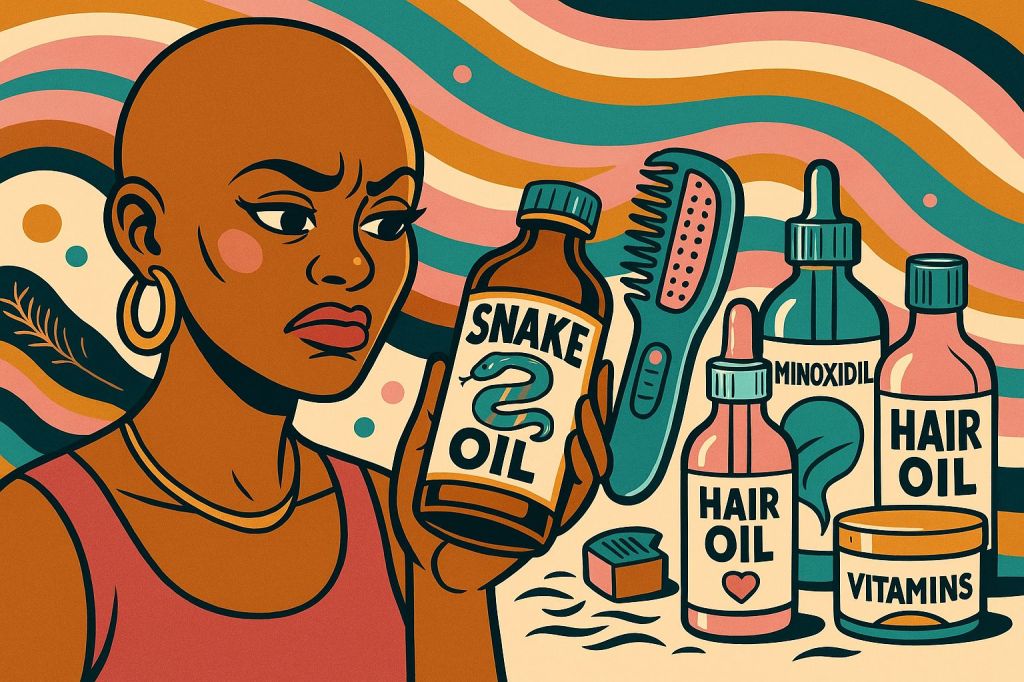
      1. Snake Oils and Fake Promises: Navigating the Hair Loss Hype

        Snake Oils and Fake Promises: Navigating the Hair Loss Hype

        Hair loss can feel like a personal vendetta from Mother Nature herself. In a market saturated with miracle cures, from laser combs and minoxidil lotions to exotic hair oils, shampoos, PRP treatments, and vitamins, it’s easy to see why many of us end up feeling duped, pockets emptier and hope dwindling.

        My Personal Journey with the ‘Miracle’ Products

        Over the years, I’ve dipped my toes into almost every trendy hair regrowth remedy available. I’ve tried:

        • Laser Combs: Promising to wake dormant follicles with a bit of light therapy. Spoiler alert: my hair didn’t exactly start a revival tour.
        • Minoxidil Lotion: Applied religiously, but the results were as elusive as Bigfoot.
        • Hair Oils & Shampoos: Lavishly marketed with testimonials and “miracle ingredients,” yet my hair remained stubbornly unimpressed.
        • PRP (Platelet-Rich Plasma): A fancy name for having your own blood re-injected into your scalp, no magic, just injections. Hurt like hell and I was £600 out of pocket!
        • Vitamins: Because if a multivitamin can fix everything, why not my hair loss? Unfortunately, the bottle’s contents didn’t contain any secret hair-growing elixir.

        Despite these attempts, the results were not what I hoped for. I learned the hard way that some of these treatments often target our desires for a quick fix, leaving us chasing after ever-more-expensive solutions.

        A Sensible Approach: Consult Your GP First

        Before you fall prey to the next “revolutionary” hair loss solution, consider taking a step back. The first logical move is to visit your GP and get your blood tests done. Why? Because hair loss can sometimes be a symptom of an underlying issue, be it hormonal imbalances, nutritional deficiencies, or other health concerns, that might actually be treatable.

        If your blood work comes back normal, your next best step is to seek out a dermatologist who specialises in hair-loss. A specialist will be able to diagnose your type of hair loss and advise whether there’s a viable solution for your specific situation or if, like many of us, you’re currently in the “no cure available” club.

        The Reality of Hair Loss Remedies

        There is no magic potion, no holy grail that can guarantee hair regrowth for everyone. The market is awash with snake oils designed to prey on our insecurities and our yearning for a return to our youthful locks. It’s a tough lesson, but sometimes the most empowering choice is to embrace your current look, whether that means rocking a wig, a stylish head scarf, a buzz cut, a topper, or a stylish weave with pride.

        A Note of Caution and Some Wit

        Disclaimer: I’m not a medical professional. This post reflects my personal experiences and should not be taken as professional advice. What works for one person may not work for another.

        In the meantime, let’s face it: if there were a magic pill that restored hair instantly, the lucky inventor would be rolling in millions. Until that day arrives, stay informed, do your research, and don’t let false promises drain your wallet or your hope.

        In Conclusion

        The journey through the world of hair loss treatments is riddled with promises as slippery as a snake’s oil. By consulting with healthcare professionals, starting with your GP and then a dermatologist, you can get to the root of the problem (pun intended) and make informed decisions. Remember, hair may be on the fritz, but your confidence and sense of humor should always be in full bloom.

      2. To Shave or Not to Shave—That is the Question

        To Shave or Not to Shave—That is the Question

        There comes a time in every hair loss journey when you have to ask yourself: Do I just shave it all off? For me, that time arrived when my bio hair had become so thin that the only style I could manage was a teeny, tiny bun on top of my head. Not cute, not functional, and definitely not working with my wig routine.

        Since I wear full lace wigs and use Walker Lace Front Tape (½ inch) to secure them, I need a clean, smooth surface to get the best hold. I tape both the front and the nape for a solid 5–7 day wear. But there was a problem, the tape at the nape kept peeling off because my hair was getting caught in it. Annoying? Yes. Fixable? Also yes. The only solution was to shave the area.

        Facing the Fear

        Now, let’s be real, shaving my head felt terrifying. I wasn’t mentally ready to go full-on buzz cut just yet. But I also couldn’t keep battling tape that refused to stick. I had hit a cross road and it was making me feel frustrated so, I decided to ease myself in with baby steps.

        Step one: I bought some hair clippers from my local supermarket. Not some fancy, overpriced one, just a basic clipper that could do the job. Then, I took a deep breath and shaved a small section at the nape, about 4 inches wide and 1 inch high. The result? I looked like I had some sort of futuristic barcode at the back of my head. But guess what? It wasn’t that bad! In fact, it felt weirdly liberating and, most importantly, the tape stuck like a mother!

        Shaving = Freedom (and a Flawless Wig Install)

        Encouraged by my little victory, I started shaving more “anchor points” i.e. strategic areas where my wig tape needed maximum grip. Turns out, I don’t actually mind shaving parts of my bio hair when it means my wig stays secure AF. Now, I even shave my temples (I have a low hairline, and those baby hairs were just getting in the way).

        So, Should You Shave?

        If your hair loss has reached a stage where you no longer feel comfortable wearing your bio hair in public and you’re toying with the idea of shaving it all off, don’t panic. You don’t have to go all in at once.

        Try this instead:

                    •           Start with a small section at the nape this area is usually covered by your wig, so you won’t have a heart attack every time you catch yourself in the mirror.

                    •           See how it feels spoiler: it’s not as scary as you think.

                    •           Enjoy the insane improvement in your wig security.

        Taking these small steps has made me realise that when the time comes to shave my whole head, I’ll be ready. It’s all about trial and error, feeling the fear and doing it anyway.

        So, if you’re standing in front of the mirror, clipper in hand, wondering whether to shave or not?just know, you’ve got this! And if all else fails, remember: barcode chic is in.

      3. Navigating the Workforce with Hair Loss: Confidence, Wigs & Workplace Woes

        Navigating the Workforce with Hair Loss: Confidence, Wigs & Workplace Woes

        Starting a new job or even just walking into the office after a weekend can feel daunting. Now, add hair loss into the mix, and suddenly, your first concern isn’t the overflowing inbox – it’s whether Karen from accounts is side-eyeing your new fuller, thicker hair and mentally filing a workplace investigation into your scalp.

        But here’s the thing: most people are too busy worrying about themselves (or that mountain of work on their desk) to notice that your hair has gone from fine to fabulous overnight. And even if they do? So what? This is your journey, and the only thing you should be adjusting is your confidence – not your wig.

        If you’re navigating the working world with hair loss, whether you’re rocking wigs, weaves, toppers, or extensions, here’s how to do it without stress (or paranoia about a rogue lace front).

        1. The “Wait… Was Your Hair Always That Thick?” Moment

        Ah yes, the classic workplace hair transformation. You’ve walked in with thin, wispy strands for months, and now – bam! – you’ve got gorgeous volume and length. Someone is bound to notice, right?

        Maybe. But let’s get real: people are forgetful. Unless you’ve gone from a buzz cut to Rapunzel overnight, most won’t even put two and two together. And if they do? Own it.

        Possible responses to the inevitable questions:

                          • Nosy Colleague: “Wow, your hair looks different!”

                          • You: “I know, right? Finally figured out how to style it properly!” (Technically true.)

                          • Nosy Colleague, still pushing: “Did you do something to it?”

                          • You: “Yep! Gave it a little boost.” (Also true – just didn’t mention the wig, weave, or topper doing the heavy lifting.)

        Remember: Your hair, your business.

        2. The Workplace Wig Worries: Is My Lace Showing?

        Look, we’ve all had that moment – sitting in a meeting, hyper-aware of the air conditioning blasting directly onto our lace front, wondering if our edges are now floating mid-air for all to see. Or the classic mirror-check panic in the bathroom: “Has my wig shifted? Is my topper dislodged? Am I about to go viral on TikTok as ‘Wig Lady’?”

        Relax. 99% of the time, it’s in your head (literally and figuratively).

        How to Secure Your Hair in the Workplace:

                          • Use a good adhesive or wig grip if you’re worried about movement.

                          • Check in the mirror once, then let it go – excessive mirror-checking makes you more anxious.

                          • Confidence is key. The less you fidget, the less anyone notices.

        And if you do catch someone staring? It’s probably because they love your hair. Own it.

        3. Hard Hats, Helmets & Hair Loss: Managing Wigs in Manual Jobs

        Not everyone works in an office where the biggest hair challenge is an overenthusiastic aircon. Some of us are out there wearing hard hats, helmets, or company-mandated caps – and let’s be real, wigs and headgear can be a tricky combo.

        Tips for Wearing a Wig with Workplace Headgear:

                         • Opt for a secure, breathable wig cap to prevent slipping. Hat fall wigs are great for this.

                          • Use a wig grip band for extra hold under hats or helmets.

                          • Choose a low-density wig or topper – bulky wigs can make hats uncomfortable.

                          • Test your setup at home before rocking it at work.

        4. Customer-Facing Roles: “What If Someone Notices?”

        If you work in retail, hospitality, or any job where you interact with the public, it’s easy to worry about what customers might think. But here’s the reality:

                          • Most customers barely look at you. They’re too focused on what they need (food, service, directions, their next latte).

                          • Confidence sells. Whether it’s an idea, a product, or yourself
        – if you act like your hair is natural, people will believe it.

                          • People change hairstyles all the time. Wigs and toppers aren’t that different from a new cut, color, or a fresh blow-dry.

        If you ever feel self-conscious, remind yourself: Your hair doesn’t define your skills. Your ability to do your job does.

        5. Limiting Beliefs Are the Real Workplace Problem

        Worrying about your hair in a work environment can hold you back more than the hair loss itself. Let’s break down some of those limiting beliefs right now:

                          • “People will judge me.” → No, they won’t. They’re too busy worrying about themselves.

                          • “I have to explain my hair change.” → No, you don’t. Change is normal.

                          • “I can’t wear a wig at work.” → Yes, you can. Millions do.

                          • “What if my wig moves?” → Then you adjust it. Life goes on.

        The real workplace power move? Owning your look and focusing on what matters—your career, your goals, and your growth.

        Final Thoughts: You Run the Show (Not Your Hair)

        Navigating the workforce with hair loss—whether you’re in an office, working a manual job, or serving customers – comes down to one thing: confidence. Your hair (or lack of it) doesn’t define you – your skills, talent, and work ethic do.

        So, step into that workplace like you own it (because, in many ways, you do). Your hair is just one part of you – but your confidence? That’s what truly stands out.

        Now, go forth and rock your wig, weave, topper, or whatever makes you feel like a boss. Because trust me – nobody’s paying as much attention as you think.